
Nashville Police Blotter Records
Nashville Police Blotter searches are unusually strong because the city publishes both official incident data and active dispatch data through Metro Nashville systems. A search can start with MNPD open data, move to the Central Records Division for a report copy, and then shift to Davidson County booking or court records when the case continues past the first incident. This page explains how to search Nashville police blotter sources, how the records request process works, and where Nashville users should look next when they need arrest, booking, crash, or court follow-up information.
Nashville Police Blotter Facts
Nashville Police Blotter Search
The main agency for a Nashville police blotter search is the Metropolitan Nashville Police Department. The department serves the city through the consolidated metro government and handles patrol, investigations, and records requests. Research identifies police headquarters at 600 Murfreesboro Pike and the Central Records Division at 811 Anderson Lane, Suite 100, Madison, Tennessee 37115. That split is important because headquarters and records processing are not in the same place. If you are using a Nashville police blotter entry to locate a formal report, Central Records is usually the next stop.
Nashville also stands out because it offers citywide incident and dispatch datasets through official open-data platforms. That gives local users more ways to start a Nashville police blotter search without filing a request first. Few Tennessee cities are this transparent. The open data helps you identify incident numbers, report categories, and live activity before you ask for the underlying report.
The Metropolitan Nashville Police Department page is the first official stop for most Nashville police blotter searches.
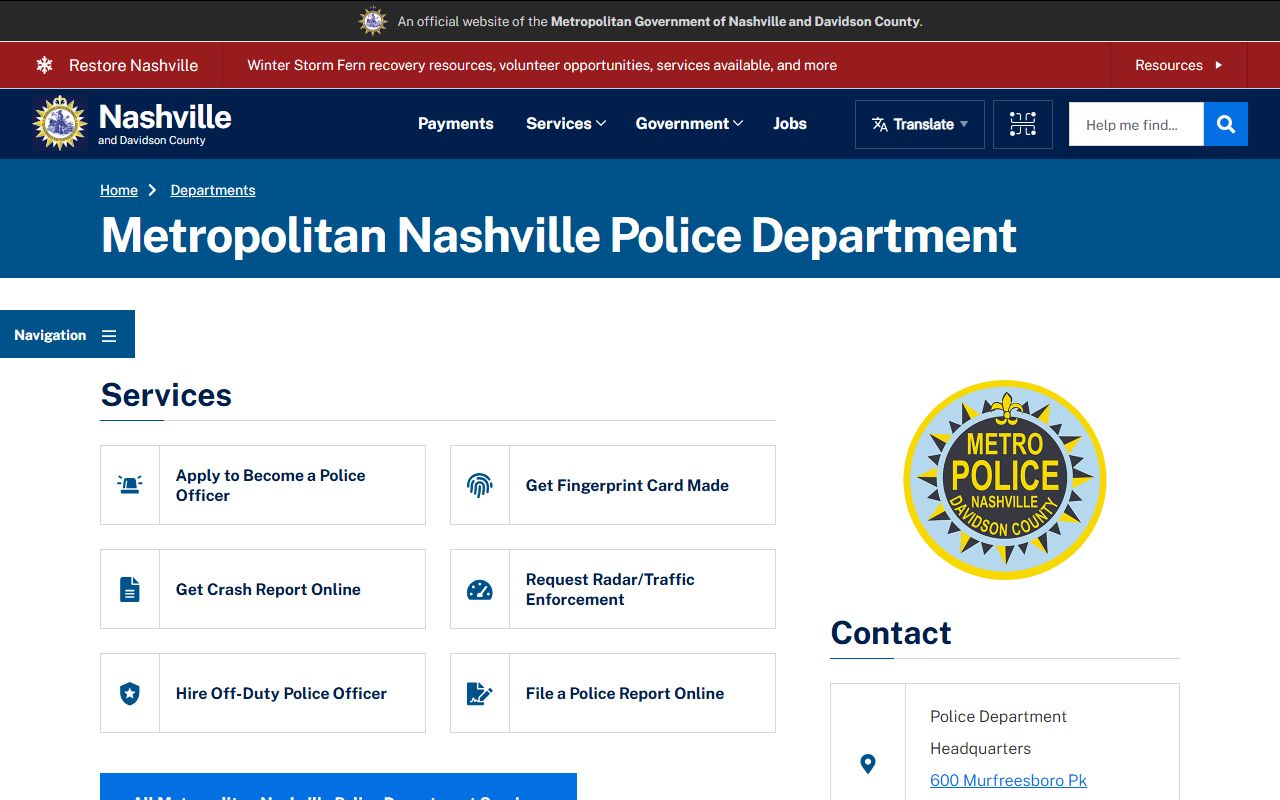
It is the best place to confirm contact information, records procedures, crime statistics links, and the official Nashville police blotter ecosystem.
Nashville Police Blotter Data
The most useful Nashville police blotter source for broad searching is the MNPD incidents dataset. Research says it includes fields such as primary key, incident number, report type, report type description, incident status code, incident status description, and investigation status. It is updated regularly and available for public download. That means users can do more than read a static log. They can filter, sort, and trace incident details through a real city dataset. For Nashville police blotter work, that is a major advantage.
The city also runs an active dispatch dataset that shows current police activity and calls for service. This is not the same as a final report, but it adds live context to a Nashville police blotter search. If you want to know what is happening now rather than what already cleared, active dispatch is the right source. If you want a completed incident file, the report request process is still required.
The Nashville police incidents dataset is one of the strongest official city police blotter sources in Tennessee.
Use it to identify incident numbers, status descriptions, and report types before you contact Central Records for copies.
Nashville Active Dispatch
The active dispatch page gives Nashville residents and researchers a real-time window into current calls for service. It updates continuously, which makes it useful when a Nashville police blotter search is really about fresh activity rather than an older report. Users can often see that a response is active before any formal incident report is ready. That said, dispatch data is a live operations view. It is not a final legal record, and a call visible in dispatch may still lead to a report, an arrest, no action, or a later records request.
The city research makes clear that Nashville offers both historical and live tools. Use active dispatch to see what is happening now. Use the incidents dataset to search completed entries. Use Central Records when you need the report itself. That sequence keeps a Nashville police blotter search efficient and accurate.
The Nashville active dispatch feed is the live side of the Nashville police blotter process.
It is best for current police activity, while records copies and incident reports still flow through formal Nashville police blotter request channels.
Nashville Police Blotter Requests
If the open data is not enough, the next step is the Nashville police or incident report request page. Research says requesters must submit the proper form with a copy of photo ID and send it to MNPD. The research also lists MNPDPublicRecordsRequests@nashville.gov as the request email. This fits the broader Tennessee Public Records Act framework under Tenn. Code Ann. § 10-7-503, which opens many local records to Tennessee citizens while still allowing redactions and withholding where another law applies.
Nashville users should expect some limits. Active investigations may not be released right away. Juvenile records are generally restricted. Sensitive personal details may be removed. Those limits do not make the Nashville police blotter system weak. They just define where the line sits between public access and protected information. A careful request that includes the incident date, location, names involved, and incident number will usually move faster than a vague request.
Note: For copies, Nashville may still require Tennessee residency proof even when the open-data side is accessible to the public.
Nashville Crash And Stats
Nashville research also points to a separate online accident report system with a listed fee of $6.00 per report. That matters because crash reports often sit beside police blotter interest but follow a different access path. If your Nashville police blotter search is really about a traffic event, the accident-report portal may be faster than the general records route. The research also notes that some reports may need additional processing time.
For citywide trends, Nashville publishes crime statistics through MNPD. Research cites 33,848 reported crime index offenses in 2017 and notes MNPD participation in the FBI UCR and NIBRS reporting systems. Those statistics do not replace a Nashville police blotter search for one event, but they help explain why the city has built strong public data tools around police reporting.
Nashville Booking Follow Up
When a Nashville police blotter entry leads to an arrest, the next public step often sits with Davidson County rather than with MNPD. Davidson County correctional research describes hourly inmate updates, a 48-hour booking list, and several searchable identifiers through sheriff-managed systems. The sheriff side, not the police side, is where users should look for booking status, housing location, bond details, and many inmate records. That is common in Tennessee, but Nashville makes the city-county handoff especially visible.
For court follow-up, Nashville users can move to the Criminal Court Clerk of Metropolitan Nashville and Davidson County. For jail follow-up, they can use the Davidson sheriff systems. For the original incident narrative, they come back to MNPD. A good Nashville police blotter search usually touches all three offices in that order.
Davidson County Police Blotter
Nashville sits inside Davidson County, so city searches often need the county page for booking, warrant, and court follow-up information. The county page explains the sheriff-managed jail system, criminal court clerk access, and county-specific public records path in more detail.
Nearby Tennessee Cities
Use nearby city pages when a Nashville police blotter search may actually belong to another local police department or nearby county system.